Our History
At one time, an ancient forest grew on Capitol Hill in North Burnaby, on the hill’s sloping north side. On the City of Burnaby’s thermal maps, it is still one of the two coolest places in the city, along with the north side of Burnaby Mountain. It still has 100 year old cedars, Douglas firs, hemlocks, and maples. Their ancestors lived right here, growing to be 300, 400, and 500 years old.
But our once abundant and flourishing forest has been disturbed many times in the past 150 years. Logging, roads, houses and gardens, refineries, electric power lines and petroleum pipelines have all had their effects. Those disturbances have enabled people – including members of this Society – to build and live on the hill.
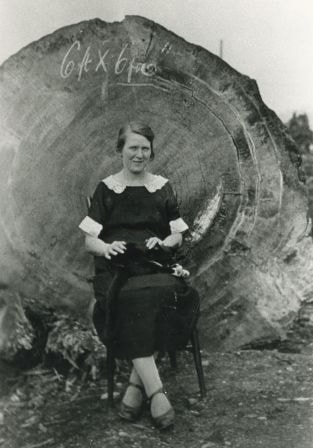
In front of the remains of a 500+ year old tree, sits Annie Eshelby and her cat in 1924. This tree was felled on the southeast side of Capitol Hill at Dundas and Fell streets in 1924. We have found more than 25 stumps of trees this size in the Conservation Area of the Hill. The whole area was an old growth forest.
Eshelby was waiting for her house to be built, but only when the trees were removed from the land, and when the wood arrived from the saw mill to build it.
Where We Are
We acknowledge that the trees and forest on Capitol Hill, and our homes and buildings, are on the unceded traditional territories of the Squamish, Musqueam and Tsleil-Waututh nations: they too draw satisfaction and benefits from this forest.
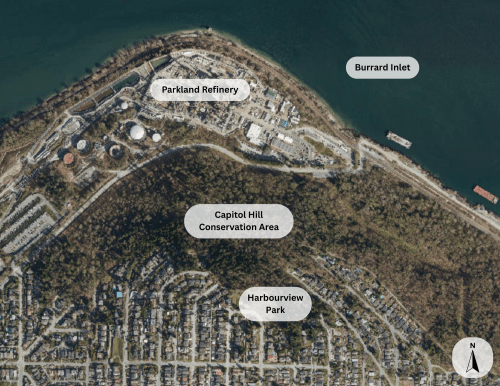
The northern side of Capitol Hill is defined as a Conservation Area by the City of Burnaby and is currently protected under the City’s Tree Bylaw. Members of the Capitol Hill Tree Keepers Society are focusing on forest conservation and regeneration in response to the increasingly higher summer temperatures, variable and uncertain rainfall [with occasional droughts], and Burnaby’s need for canopy-shade and cool. This forest should no longer be disturbed in the ways that it has been in the past. And it can be stimulated to regenerate and evolve.
Our Work
Much of our work as the Capitol Hill Treekeepers involves managing invasive plants within the forest and organizing nature walks. These events are a chance to connect with neighbours and the forest.
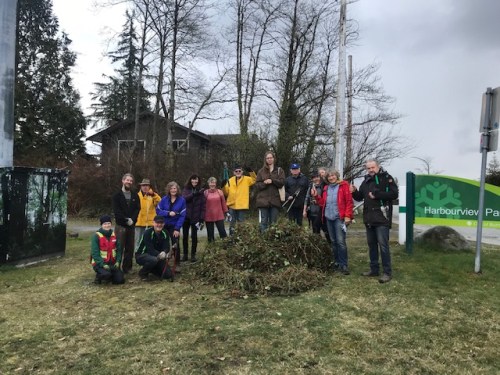
Managing these invasive plants helps increase biodiversity and support native plants. Some plants, like ivy, can also grow up trees and increase the weight and area of the trees making them more at risk of falling in wind events. Invasive shrubs and trees such as holly and cherry laurel compete for resources from young establishing native trees.
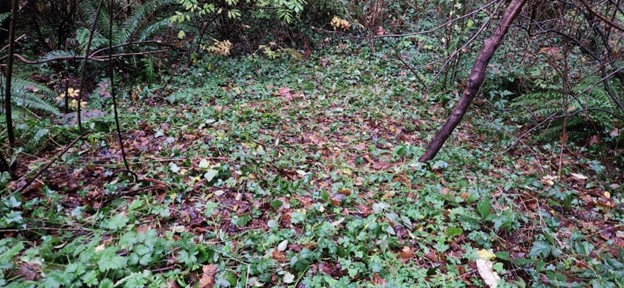
The area above was cleared of invasive ground ivy in spring 2024. Six months later, resilient native plants like trailing blackberry are beginning to regenerate. Insects and small animals love these native plants.
The Trees
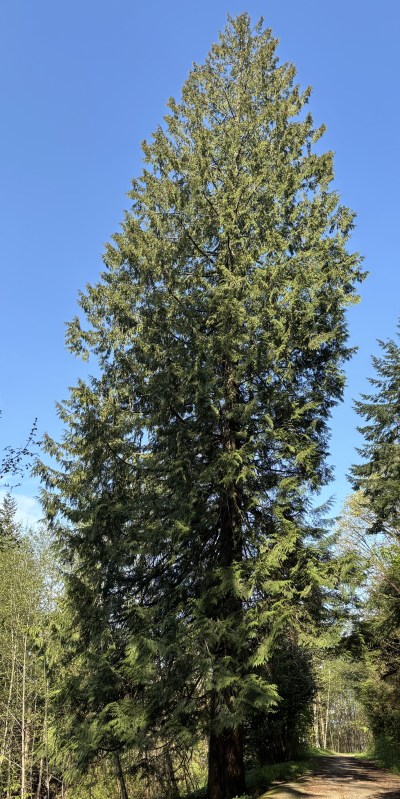
This one hundred year old cedar Mother Tree on Scenic Drive, north side of Capitol Hill, was too small to be cut down when the area was logged about 1920.
The cut-bank above it is always wet, suggesting an underground water source. When the house beside it was demolished in 1990, this tree’s entire root system was buried under tons of construction debris. Yet the babies from this mother tree have pushed their way up through bricks and concrete to the light.
There were old trees like this all over Capitol Hill in the 1970s. Most of those on private land or boulevards are gone now, although the City wisely conserved a cluster of them in a tiny park on the lower southern slopes of the hill near Hastings.
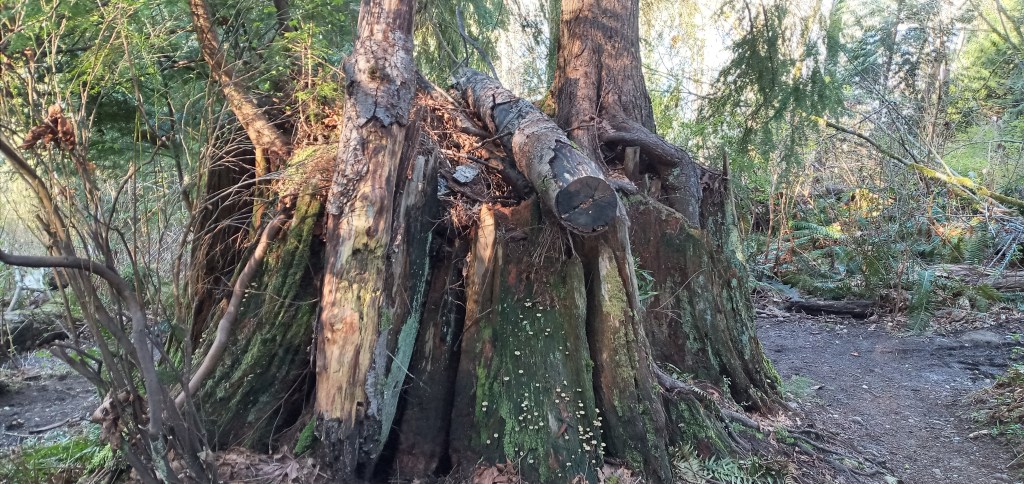
Large stumps are everywhere within the Capitol Hill Conversation Area. These stumps are now acting as nurse logs for new growing plants including hemlocks, salal, red huckleberry and more.
One hundred year old stump of an ancient cedar tree, cut down circa 1920. Old cedar stumps are tough, resist insects, stabilize the slope, and sometimes become the sites of new trees.
If you are interested in the Society, or have ideas for us and the forest, please contact us at capitolhilltreekeepers@gmail.com.
The directors for the Capitol Hill Treekeepers Society are:
- Chair: Bob Anderson
- Vice Chair: Darlene Gering
- Treasurer: Dianne Kilback
- Secretary: Michele Joel
- Director at large: Erica Mulder
 Capitol Hill Tree Keepers